Merger and acquisition (M&A) activity in the property and casualty (P&C) industry slowed in recent years, a period of significant financial strain on insurers.i While personal lines underwriting results showed signs of recovery in 2025, certain commercial lines face ongoing challenges.ii
A potential upcoming slowdown in P&C premium growth may make mergers, acquisitions, divestitures, and capital partnerships more attractive again despite the ongoing challenges from economic conditions, social inflation, and climate risk. A disciplined assessment of company fundamentals, supported by thorough due diligence, continues to be essential to distinguish genuine opportunities from potential costly missteps.
In this article, we take a look into the recent trends in P&C insurance M&A activity and the forces that have shifted how M&A opportunities are evaluated.
What are the latest trends in P&C M&A deal volume and size?
P&C insurance M&A activity has historically revolved around familiar ambitions: growth, scale, margins, market share, and strategic expansion. Deals targeting technology/insurtech capabilities and new distribution channels have also been common M&A themes in recent years. However, the number of P&C deals has declined in the last eight years, while the average deal value has risen significantly.
Figure 1: Number of deals and average deal value for P&C transactions, as of 5/31/2026iii
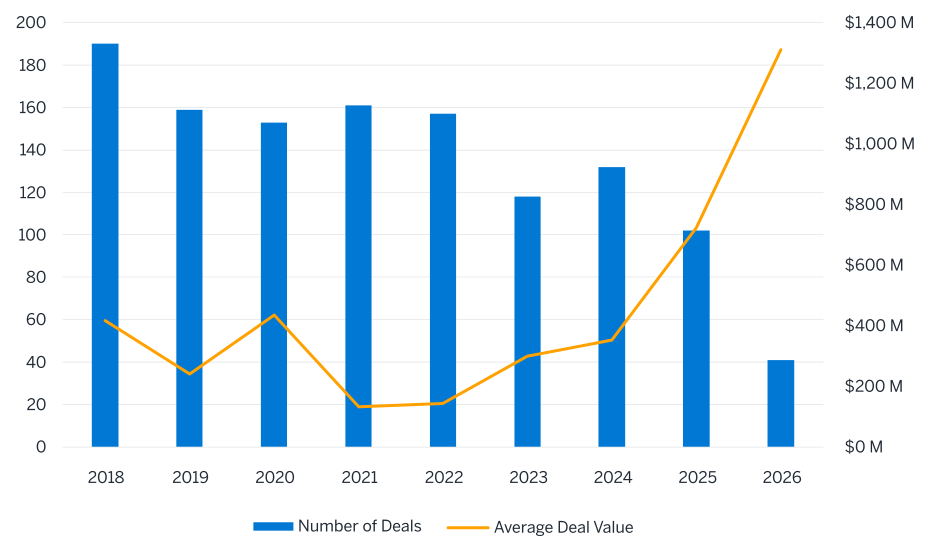
More than 80% of the sellers in P&C transactions during this period had primary operations in North America and/or Europe, but volume declined across all regions. North America fell from 83 deals in 2018 to 47 in 2025, while Europe dropped from 66 to 35. Through May 2026, activity appears broadly in line with 2025, with 41 announced P&C deals versus 43 in the same period a year earlier.iv
At the same time, average deal size increased sharply in 2025, and data through May 2026 indicates that deal sizes may be even bigger in 2026. From 2018 to 2021, “megadeals” ($500 million-plus) made up about 80% of announced deal value; in 2025, megadeals made up 93% of announced deal value, including the following deals valued at over $1 billion eachv:
- Ageas (UK) Ltd. agreed to acquire esure Group plc from Bain Capital, LP, for $1.7 billion, creating the third-largest personal lines platform in the United Kingdom.vi
- Sompo Holdings subsidiary Endurance Specialty Insurance agreed to acquire Aspen Insurance Holdings Limited from Apollo Global Management for $3.5 billion, supporting Sompo’s expansion in specialty P&C.
- DB Insurance agreed to acquire The Fortegra Group for $1.7 billion, the largest U.S. acquisition by a Korean non-life insurer.
- AIG and Onex Corporation jointly acquired Convex Group Limited in a $7 billion transaction, giving AIG greater specialty exposure while strengthening Onex’s insurance platform.
What is driving P&C M&A deal trends? A challenging economic backdrop and a more volatile risk environment have altered how buyers assess insurance targets. Rising interest rates, social inflation, reserve uncertainty, profitability pressure, and climate risk have all reduced the number of straightforward deals and increased the valuation uncertainty, resulting in more rigorous due diligence efforts. We have laid out five trends that potential investors, buyers, and sellers should be mindful of when considering a transaction in the P&C market.
M&A trend 1: With shifting interest rates, P&C insurers proceed with caution
One of the clearest shifts has come from higher interest rates. Rate increases from 2022 to 2024 reduced valuations by lowering the present value of future earnings and made debt-funded acquisitions more expensive. Buyers became more selective and more cautious about when to deploy capital.
The effect extends beyond financing, though. Higher rates have increased valuation scrutiny, pushing buyers to focus on underwriting quality, reserve adequacy, and the durability of earnings. In some cases, sellers remained anchored to earlier pricing expectations, widening bid-ask spreads and slowing negotiations. That said, higher rates are not entirely negative for P&C insurers, since improved investment yields can support increased earnings. But that benefit has not offset concern about financing costs and execution risk in acquisitions.
While interest rates started to gradually dial back in 2025, the overall effect is quite clear in the current M&A market: fewer easy deals and a higher bar for execution.
M&A trend 2: Social inflation increases uncertainty for P&C insurers
If higher interest rates have made buyers more disciplined, social inflation has made them more wary. Larger jury awards (including the increasing frequency of nuclear verdicts), broader liability theories, aggressive plaintiff strategies, third-party litigation funding, and longer settlement times have increased casualty claim costs and added uncertainty to insurers’ financial positions.
For M&A, that means buyers want deeper due diligence into claim trends, legal environments, and line-specific exposures such as commercial auto, general liability, and excess casualty. Because the risk is difficult to quantify, buyers often respond with lower valuations or more conservative structures.
Social inflation has also changed what buyers value. Underwriting discipline, pricing responsiveness, and claims management matter more than ever. Litigation-sensitive casualty books may still attract interest, but they are more likely to face tougher diligence.
M&A trend 3: For P&C insurers, reserve adequacy is no longer a footnote
In today’s market, reserve adequacy concerns can quickly move from a due diligence issue to a deal-breaker. If an acquirer believes a target’s reserves are inadequate, the consequences are straightforward: lower valuation, more difficult negotiations, and a much greater chance that the transaction will not move forward.
This is especially true in long-tail lines, where reserve adequacy is difficult to assess and adverse development can emerge years after policies are written. Buyers are therefore reviewing historical reserve movements more intensely, examining actuarial assumptions, trends embedded in claim triangles, jurisdictional exposure, and large-loss trends to judge whether future earnings and capital could deteriorate after closing. As a result, insurers with stable reserve histories, transparent claims data, and cleaner balance sheets are better positioned in the market. Companies with reserve volatility may still find buyers, but deals tend to involve challenging negotiations and added protections.
M&A trend 4: Demonstrating profitability is key for P&C insurance companies
Even when reserves appear adequate, uncertainty around profitability can still weigh on M&A-related decisions. If future earnings are difficult to forecast, buyers struggle to justify premium valuations and respond with more intensive diligence focused on pricing trends, legal/regulatory risk, claims management, and underwriting discipline.
The result is a more selective market. Targets attract less interest unless they demonstrate strong pricing, effective claims management, and adaptability to changing loss trends. Buyers are correspondingly drawn to businesses with more predictable earnings, including insurers with blocks of short-/medium-tailed businesses, diversified platforms, and fee-based models such as brokerages and managing general agents.
M&A trend 5: Climate risk and geographic concentration can impact deal attractiveness for buyers and sellers of P&C insurance companies
Shifts in catastrophe risk have reshaped the landscape for buyers as much as economic shifts have. In a world with more frequent and severe natural catastrophes, catastrophe exposure remains a central due diligence question.
With the advent of sophisticated technology platforms, buyers are looking more closely at exposure to hurricanes, wildfires, floods, convective storms, and other weather-related risks. That can mean lower valuations and a narrower buyer pool for insurers concentrated in catastrophe-prone regions, given the challenge of forecasting earnings under increasing climate volatility.
Geographic concentration is another important factor. A regional insurer with heavy disaster exposure may be less attractive unless a buyer has a clear strategic rationale for that market. Diversified books of business, by contrast, are gaining favor because they offer greater resilience to localized shocks.
Climate risk has also elevated the importance of a strong catastrophe reinsurance program. Buyers want to understand not only whether protection exists, but also its cost, provider quality, and performance under major loss scenarios. Reinsurance quality remains a core part of the investment case.
Catastrophe exposure does not automatically make a target unattractive. Specialist buyers may still see opportunities if they believe they can improve underwriting, pricing, analytics, or reinsurance strategy—but these are now deliberate bets on risk-management capability, not simple expansion plays.
Conclusion: P&C insurance M&A transactions require enhanced due diligence
Taken together, these trends have highlighted the need for enhanced due diligence in potential P&C insurance M&A transactions. Buyers are increasingly focused on underwriting quality, durability of profitability, and a target’s underlying risk profile, rather than on scale alone and asking more complex and challenging questions about reserves, catastrophe exposure, reinsurance quality, rate adequacy, geographic concentration, and claim trends.
Successful P&C insurance M&A deals depend on rigorous assessment of insurance operations and financials. Actuaries play a central role in this process—especially in cross-border deals, where local market and regulatory expertise matter.
Milliman’s M&A experts bring decades of experience to evaluating potential investments in P&C insurers. We assess reserves, reinsurance, and projected underwriting and investment earnings, and we complement that analysis with claims, underwriting, and process reviews to evaluate operational strength alongside financial performance. Milliman works both with buyers to evaluate target market opportunities and sellers to help prepare for buyer due diligence.
In the next installment of this series, we will look more closely at the methods and resources used to assess reserves, rate adequacy, pricing sophistication, and related diligence topics.
i Nibbelin, L. (May 14, 2026). U.S. P/C market records hard-earned decade-low combined ratio.” The Triple-I Blog, Insurance Information Institute. Retrieved July 7, 2026, from https://insuranceindustryblog.iii.org/u-s-p-c-market-records-hard-earned-decade-low-combined-ratio.
iii S&P Global Market Intelligence (and its affiliates, as applicable), public data, and Milliman analysis.
vi Tomlin, J., & Mullan, R. (2026). “Trends in UK property and casualty insurance mergers and acquisitions”. Milliman Insight.